Inspiring Entrepreneurs: Mothers of Invention

Last week was a busy one for me with three events worth noting. The most memorable, for two reasons, was our Inspiring Entrepreneurs: Mothers of Invention evening.

One, because – sadly this is likely to be last of our Inspiring Entrepreneurs events for the foreseeable future, due to our funding running out. Secondly, because I got to show Natasha Kaplinsky around the Business & IP Centre. She got quite excited about our Success Stories, in particular the David versus Goliath saga of Mandy Haberman’s Any Way Up Cup.

Natasha had kindly agree to chair our session of four inspirational and pioneering female entrepreneurs.

Although businesses run by women contribute £130 billion a year to the UK economy, still only 15% are led by women. I am proud to say that 50% of the people we help in the Business & IP Centre are women, so we are doing our bit to help redress this inequality.

Mama-MioSian Sutherland the co-founder of Mama Mio skincare was our first speaker. Since starting five years ago Mama Mio is now distributed in 2500 stores and five spas in eight countries.

Their mission is very simple and straightforward – to be the most recommended skincare brand in the world.

Sian described the three key ingredients to competing – Business, Brand and  Product.

To her brand is the most important ingredient for long term business success. And that chimes with several of my recent blog posts on the subject of branding.

She explained how you need to gain brand loyalty using emotion, rather than price.

Sian’s vital ingredients for success:

  • ­        learn from the mistakes of others
  • ­        use the ‘why bother test’
  • ­        don’t follow trends or fads
  • ­        understand who your customer is
  • ­        know how to talk to your customers
  • ­        have a unique and own-able brand tone of voice
  • ­        deliver on every level to your customers
  • ­        make you customers feel special
  • ­        have a plan
  • ­        if it was easy, everyone would do it
  • ­        love what you do, and do what you love

Sara Murray is serial entrepreneur having founded the price comparison website, confused.com and more recently developed buddi, a miniaturised tracking device for vulnerable people..

She told us that success does not come overnight. It takes on average eight years for a business to become successful.

Buddi is Sara’s third business, and the initial idea was to give the product away and charge a rental. However this approach was rejected by her investors, so she went back with a revised plan which was accepted. So the lesson there, is be adaptable.

She said that luck favours the persistent, failure is good, and that you shouldn’t wait for the big idea to come along – just get on with it and see what happens.

Every product however good will eventually becomes obsolete, so you need to develop a range of products in order to have a successful business.

For funding, forget about the banks, use Angel investors, friends and family.

Vanessa Heywood created  Tiny Mites Music in 2004 to provide music and drama classes for pre-school children. By 2010, Tiny Mites Music was being performed in over 80 day-care nurseries and at holiday parks across the UK.

In November 2010, Vanessa was the recipient of the Stelios Award for Disabled Entrepreneurs.

She told her heart-rending story of having to bring up two small children on her own while trying to cope with MS.

Shazia Awan is the founder and Director of Peachy Pink.  a ladies shaping and anti-cellulite underwear brand launched in 2009. In late 2010, Shazia introduced Max Core, shaping and posture-control garments for men.

Every bank she went to for funding said the business would fail, so Peachy Pink started with life based on her savings and credit card.

The great thing about starting your own business is that no one can tell you how to market your products.

Peachy PinkPeach Pink was launched with fifty women walking down Oxford Street just wearing their underwear. This generated a great deal of press coverage for free.

Now Shazia has launched a search for the peachiest bottom in the UK

Last year she launched Max Core for men, a posture control clothing, purely from demand from customers. Her initial product line sold out within a week.

She feels that unique selling points are key for new products, for use in marketing and promotional activities.

Success comes from a great product, innovation and PR.

Insider Trends – The Future of Online Marketing

logo_insider_trendsOnce again Insider Trends founder and all round marketing guru Cate Trotter raced through an enormous number of ideas and examples.

Tonight’s topic was the Future of Online Marketing, and she started with a shocking prediction. If Google was dominant internet power in the 2000’s, then in the 2010’s it will be Facebook. In fact Facebook already drives more traffic to some websites that Google.

An interesting example from a recent net@night with Amber and Leo is the launch of Internet legend Guy Kawasaki’s tenth book called Enchantment. Rather than building a website to promote the book, he simply created a Facebook fan page.

Here are my notes from the excellent workshop:

Online Marketing in Context

It is big and growing fast:

– UK online retail growth is predicted to grow by 20% a year.

– 30 million UK residents already access the internet every day.

– UK Broadband has grown from 40% in 2006 to 71% in 2010.

– People are prepared to spend more money online than in the past.

– Increase in use is right across the age spectrum, with 65+ the fastest growing demographic on both the internet and Facebook.

– By the end of 2011 the majority of phones in UK will be smartphones.

o        But the number of smartphone online sales are still only a tiny proportion of online retail.

Selling Online

The evolution of online retailing. The initial advantages over bricks and mortar were price and convenience.

More recently we have seen the development of rich media and additional functionality. e.g. Spotify, with online music and social media links.

The future of e-commerce will be experiential – informative – personalised – social – convenient and reliable.

Experiential – a richer, more immersive, more interactive retail experience.

– e.g. www.leverduredelmioorto.it – a grocery services which allows you to layout your own allotment, which they plant for you, with a webcam to show how your veg is growing.

www.zappos.com – in 2010 they hosted 8,000 shoe videos on their website, and found that between 6% and 30% of viewers went on to buy a pair of shoes. So, for 2011 they plan to host 50,000 videos.

– Augmented reality

o        An IKEA app for the iPhone which places virtual furniture in you rooms.

More informative retail experiences with extra layers of information and advice.

– Amazon customer comments and recommendations system helps enhance customers buying decisions.

www.argos.com have added similar approach and increased by sales  by10%

– When you are buying apples on the Tesco website, you will be asked if you want to see recipe suggestions using apples.

More personalised shopping

www.tailor-store.com – allows you to customise almost every aspect of your shirt.

www.boutiques.com – recently bought by Google – allows you to create a personalised shopping experience.

– Tesco have released an API to open up their enormous database to developers. An example would be a recipe website which would enable you to buy all the necessary ingredients from Tesco.com with one click.

Social shopping

– iTunes recently went social, using Ping, enabling you to see what your friends are listening too and buy the same easily.

– Facebook Commerce (could it be the next big thing?)  – shops within Facebook which turn shopping into a social experience – evidence shows visitors are 2.5 times more likely to buy than on standard websites.

Confidence online has increased

– From marketing – to initial enquiry – to purchase – to delivery – and repair/upgrade.

– Facebook stores provide ease of access – reduced barrier to access – same familiar Facebook interface.

o        e.g. 1800flowers.com – a mini shop still inside your Facebook newsfeed.

www.tobi.com – a virtual reality changing room to preview online clothes.

– Dec 2010 Christmas online shopping experience – 45% had problems – 32% abandoned shop – 50% said they were unlikely to return.

o        One solution is 24 hour 365 days phone customer support. e.g. Zappos.com

o        www.nutshellmail.com – will monitor tweets or online comments about you within the hour – currently free (positive or negative)

– Simplify payments to improve the experience

o        Amazon – one click shopping – a patented (in the US) idea.

o        PayPal can sit on any website.

o        Facebook credits – still quite new – But you can already buy them in Tesco supermarkets.

Delivery

– Home delivery concerns deter 44% of online shoppers.

– Perhaps not surprising as 1 in 10 deliveries fail.

o        www.collectplus.com – using local conveniences stores for collection or drop-off – already adopted by Littlewoods etc

Marketing

Get the basics right first –Search Engine Optimisation is the number one thing to boost your online retailing.

The evolution of marketing

– Billboards, newspapers, TV etc.

-10 years since Internet marketing began in earnest.

– Now users have the same power and reach as companies.

– We are listening to each other, not companies – peer recommendations have value – advertising has the least impact.

o        e.g. Shoes of Prey – One teenage fan’s vlog increased their traffic by five times.

[youtube=http://www.youtube.com/watch?v=YQ-FrW0KraM]

o        Facebook Facepile application – lets you see which of your friends have visited a website

o        www.blippy.com – shows what you have been buying on your credit card

How do you make your brand the thing people want to talk about and share with their friends?

Two approaches – organic and nudge:

Organic

– You need to create something special to catch people’s attention.

– Quality products and service will generate positive marketing – blogs – Facebook etc.

o        www.songkick.com – tell it the bands you like – it will send you when they are playing

– Think about putting an amazing deal on your website – people will comment on it.

o        www.hoxtonhotels.com – rooms for £1, once a year

Nudge promotion – works on a sliding scale from blatant to elegant

www.lockerz.com – a blatant form of nudging – 17 million members since 2009 – all around selling – you get points for activities – many for getting a friend to do them – if you get 20 friends, your points double.

www.snatter.com – less blatant – rewards for tweets and Facebook mentions

www.tipfromme.com – benefits for sharer and share.

www.dropbox.com – service enhanced in reward for sharing with friends.

www.polyvore.com – lets customers promote themselves.

Polyvore

– Facebook Connect Comment – natural sharing.

www.skype.com – the value only comes when others use it – so at the elegant end of the spectrum.

Overall conclusion

The web is becoming more sophisticated, and more satisfying (much more product information) and more social.

Retailers will need to think how they are going to move from a marketing budget to satisfaction budget.

“If I had to guess, social commerce is the next area to really blow up”, Mark Zuckerberg (Facebook founder)

Green Metropolis – a million books to read again and again

greenMetropolisThanks once again to Smarta.com for this inspiring business start-up story, this time featuring books (a subject close to my heart).

They have interviewed Barry Crow the founder of Green Metropolis about  how he came to develop the site using his redundancy pay.

What’s your background and how did you come up with the idea for the site? I’m originally from Newcastle and worked for British Airways as an IT developer. I moved to London for my job and went from a 4 bedroom house to a one bedroom flat. I’m an avid reader and had loads of paperbacks. If people have space, their books go under the bed or on the shelf. I had no space and had to de-clutter everything. So I started giving them away to charity shops. 

I went through pretty much the same process; I would buy a new book every month, read it and then drop it off in a charity shop.  But I could never find books there I wanted to buy. If I had just finished a James Patterson, then I would want to read another one. But if the charity shop didn’t have it I would have to go to Waterstones and buy a new one.

After a while I just thought: this is crazy; there must be a better way to do this. That was the beginnings of the idea but I didn’t look at it properly until I lost my job.


How many people use the site?

We have about 100,000 members.

We started with 1,000 books in stock which were mostly mine, and a few of my friends. We have about a million second-hand books in stock now. Some members still buy books brand new, because they have to have it, but within a week they’ve read it and will post it on the site


What sets you aside from sites like Amazon or even eBay?

Our site is more like a book club; it’s a community doing it to benefit each other. It’s for people who want to share their books with each other and at the same time raise money for a good cause. It adds to the whole feel-good factor of the site.

When you join us, you get an online account and every time you sell, you can either have the money refunded to you or use it buy new books.

Everyone should benefit, whether buying or selling, and ideally, we want our sellers to have enough credit from sales to buy their next one on the site without ever needing to use a credit card.

What’s been the biggest challenge?

I think probably promoting the site. I have no experience with the marketing side of things. My background is computers and IT, so I didn’t have a problem with the technical side of the site. But I suppose I naively thought after 6 months that once we had a great website, people would naturally come to it.

Like I said, we’ve never advertised it, and it’s been a very slow process. I started off and it was just me and I massively underestimated the time it takes to do everything.

Where do you see the site in five years time?

I would like GreenMetropolis.com to be the main ethical alternative to Amazon for second hand and charity books. For myself, I would like to work a little less, so that I can read a little more.

Kate Middleton to marry Prince Harry

The most important activity for any start-up (or existing business come to that) is research. If you don’t understand your customers, your market, or your products properly, you will make mistakes. And these could cost your business.

With this in mind, it looks like Guandong Enterprises ltd failed to do their research when producing a piece of memorabilia to celebrate our forthcoming royal nuptials. Although the names are correct on the ‘Royal mug’, the image is of red-haired Harry, instead of his older brother, less colourful brother Will.

Ironically although this mug is not likely to be a best seller, its value is going to go sky-high due to the mistake.

Will and Kate
http://www.guandongenterprisesltd.com/

Kate Middleton ‘marries Prince Harry’ on souvenir mug

Join our Facebook tagathon and win a Squid London umbrella

This week we are celebrating some of the wonderful products made by our success stories, who we have helped in the Business & IP Centre. Each day there will be a chance to enter our competition to win one of their innovative products on our Facebook fan page.

We have made it easy to enter.  Just keep an eye on the Facebook fan page,  and at some point during the day we will post a photo of the ‘Business & IP Centre product of the day.’

When the photo of the item appears, tag it with your name, and at the end of the day we will randomly select a lucky winner who will be sent that item in the post.

We are kicking off with one of my favourites, an umbrella from Squid London which changes colour in the rain.

Squid_London

Are you fed up by the rainy days?

Imagine you are walking down the street, it starts to rain and your ordinary black umbrella interacts and changes colour in the rain, creating a walking piece of art – called a ‘wearable piece of art’ by Time Out New York. The inspiration came from Jackson Pollock who dripped and splashed paint onto white canvases creating a spectacle of colours.

Emma-Jayne Parkes and Viviane Jaeger are the co-founders of SquidLondon, an innovative product design brand based in London. The Squidders won several awards including the Deutsch Bank runners up, the Creative Enterprise Winner and People’s Choice NACUE and the Smarta 2010 award.

Currently SquidLondon stocks its Squidarellas in 8 major cities including London, New York Paris and Tokyo and work with significant artshops including Tate Museums, MoMA New York, the Saatchi Gallery and ArtBasel. The Squidarella has generated some excitement and publicity at BBC Radio, BBC Television and was voted in to the top 5 products in Instyle US.

The Squidders brighten up the wet and gloomy days. A simple idea, a fun gift – who does not have an umbrella? Come squidding along!

Climbing the stairway to heaven

kilimanjaro
Source tanzaniatraveldestination.blogspot.com

Now that I am in the final stages of planning my once in a life-time trip to the top of Kilimanjaro. I need to get my legs in shape for the 5,882 metres or 19,298 ft climb to the snow-capped peak of Kibo.

For some time now I have been using the stairs at work instead of the lift whenever possible. Although this sometimes gets me to high-up meetings a little out of breath, I can feel the good it is doing me. Even better, I am saving electricity each time I avoid going into the lift. In addition, I gain a sense of control, or at least avoid the frustration of waiting, what can seem like an age, for the lift to arrive.

There is even scientific evidence to prove that taking the stairs instead of the lift at work could save your life.

Banning the use of lifts and escalators led to better fitness, less body fat, trimmer waistlines and a drop in blood pressure, a study of 69 people found. This translates to a 15% cut in the risk of dying prematurely from any cause, calculate the University of Geneva team.

However, that won’t be enough to get me through seven days of equatorial trekking in July, so I am increasing my visits to the stairwell. Initially I was doing a full eight flights to the top of the building at the beginning of each day. but have now increased to twice a day. However, I’m not sure how much I will need to ‘raise my game’ in order to be fully fit for the rigours of the big mountain.

What is nice is that I’m not alone in my use of the stairs as a fitness aid. I now recognise some regulars as I pant my way up and down the floors.

In common with many mundane activities, there is often an extreme approach taken up by those I would consider to be somewhat more eccentric than the rest of us.

The Telegraph newspaper has published a couple of stories about the ‘sport’ of stair running, Stair running: Towers of torment and Could you run a vertical marathon?

And of course the highest building representing the pinnacle of achievement. For these indoor athletes, taking anything less than two steps at a time is for amateurs. And I assume the inside line is fiercely fought over for the advantage it gives. You can read about the buildings, runners and their times here: www.verticalrunning.org; www.towerrunning.com; www.skyrunning.com; Stairclimbing Sport; www.stairclimbingsport.com

Somehow I don’t think I will ever make it running to the top of the erotic gherkin or the Shard. But as someone who is allergic to gyms, using this stair climbing workout regime is a free and handy alternative.

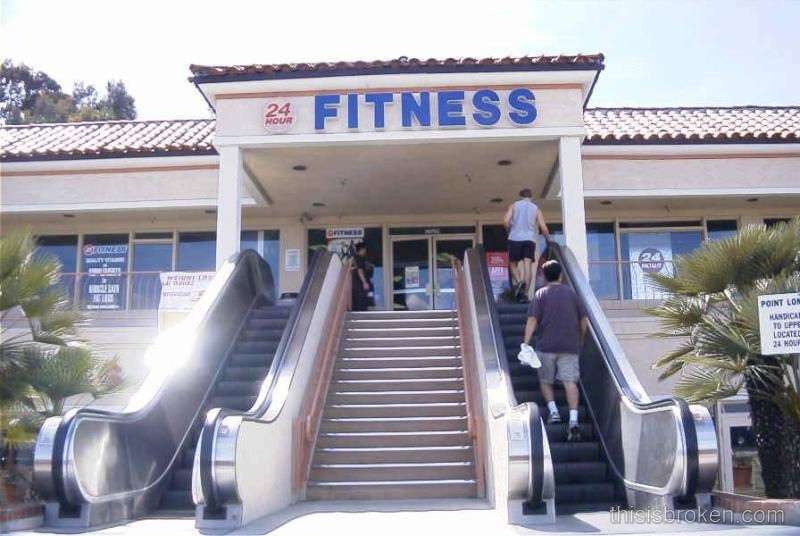
My attitude to the mindset that leads to fitness seekers to drive their cars to their local exercise centres is nicely summed up by this photo from the USA below.

Business & IP Centre is five years old today

BIPC logoWhile I am on the subject of birthdays (Escape the City is one year old), I would like to note that the Business & IP Centre is five years old today.

My colleague Isabel Oswell, who heads up our marketing activities, has come up with some helpful numbers to give an indication of what we have achieved in the last five years.

I should acknowledge the match-funding by the London Development Agency (LDA), which has enabled us to achieve so much.

I am proud to have been involved with something that has helped so many, and want to thank everyone who has helped to contribute to our success.

To date we have helped 200,000 entrepreneurs and small businesses, and given direct advice and guidance to over 30,000 people.

Fifty percent of these have been pre-start up, and 50 per cent have been post-start up and owners of growth businesses.

They come from a diverse range of backgrounds, with fifty percent women, and 37 percent from black and Asian minority ethnic groups, and 4% with disabilities.

Over a quarter of the Centre’s visitors are from the creative industries.

An independent evaluation by Adroit Economics, revealed that, between 2007 and 2009, the we helped to create 829 new businesses for London, and a further 786 new jobs for Londoners. The combined turnover for these businesses was £32 million and 89 percent of their founders say this success could not have been achieved without the Library’s help.

For every £1 that the LDA invested over the period, the businesses saw a £22 increase in turnover. Further, these businesses, supported by the Centre, have contributed £5.5 million to the public purse.

In addition, owing to its reputation and brand, the Library has also managed to leverage its funding through sponsorship, discounts, pro bono work, positive press coverage and other in-kind benefits at an estimated value of over £10 million.

.

[youtube=http://www.youtube.com/watch?v=lFbRJZLsEVs&feature=player_embedded#at=20]

Escape the City is one year old

Having worked for 16 years in the City of London for an investment firm, I can relate strongly to Escape the City.

I also used to manage a colleague, who left my team to successfully fulfil his dream of creating an alternative therapy business in New Zealand (Sacred Moves ~ Yoga, 5Rhythms Dance and Massage Therapies).

Escape the City was set up by Dom Jackman and Rob Symington who found their own way out and wanted to help others (our story).

We are on a mission to liberate talented people from unfulfilling corporate jobs.

We are assembling a community of corporate professionals who want to escape the corporate mainstream and do something different with their lives and their careers.

Our objective is to build and maintain a platform that connects these ambitious and talented people with exciting career changes, innovative business start-ups and epic adventures.

We know that there is more to life than doing work that doesn’t matter to you. We want to help people to find ways of spending their working lives doing exciting and fulfilling work.

Escape the City is now a year old and has 26,550  subscribers to their weekly escape opportunities email, and over 4,500 followers on Facebook.

Below is a clip from their new video with my favourite escape story.

EscapetheCity

.

An innocent clash of trademarks?

I’ve been thinking a lot about branding and trademarks recently (Logos with customer appeal – Apples and Marmite).

So this story in yesterday’s Evening Standard caught my eye (I’m innocent over trademark clash, says children’s vitamins maker).

Innocent Vitamins was started by Dawn Reid in July 2010, based in the tiny village of Ashurst Wood in East Sussex, close to where I grew up. According to the Standard article, Mrs Reid claims that her brand was not inspired by Innocent Drinks, and that her customers do not get the two brands mixed up.

However, the smoothie company, founded in 1999, and now with a turnover of £128 million, sees things differently. They say their customers are confused by this new brand, and that using such a distinctive name in a similar category is not an appropriate thing for another company to do.

“We have given the company a way out by respectfully asking them to stop using the brand name, which we believe is more than reasonable, and doubt that most other companies would be so tolerant. We have to protect our brand and everything we have stood for over the past 12 years.”

It seems that Mrs Reid is planing to fight to keep the Innocent Vitamins brand, so this one could run and run.

“I genuinely believe that my company can peacefully coexist with Innocent smoothies, and I would be delighted to meet up with them as we have already offered.”
http://innocentvitamins.blogspot.com/2011/03/innocent-vitamins-refutes-innocent.html

My limited knowledge of trademark law includes the topic of passing-off, and the deciding factor in many court cases is whether a reasonable person would get the two brands confused side by side on a supermarket shelf.

However, as the Intellectual Property Office IPO points out, it can be very difficult, and as a result, expensive to prove a passing off action. http://www.ipo.gov.uk/t-protect-passingoff

If you register your mark, it is easier to take legal action. This allows you to take legal action against infringement of your trade mark, rather than using passing off. Further information is available under Benefits of registered trade mark protection.

I know what I think, but have a look at the photos below and decide for yourself.

innocent_smoothieInnocent_Vitamins

The IPO have a nice summary page on Trademarks on their website.

In summary:

  • A trade mark is a sign which can distinguish your goods and services from those of your competitors. It can be for example words, logos or a combination of both.
  • You can use your trade mark as a marketing tool so that customers can recognise your products or services.
  • A trade mark must be distinctive for the goods and services you provide. In other words it can be recognised as a sign that differentiates your goods or service as different from someone else’s.
  • A registered trade mark must be renewed every 10 years to keep it in force.

Fortunately the IPO make it very simple to search their database of registered here http://www.ipo.gov.uk/types/tm/t-os/t-find.htm

Milking a story for all it’s worth

The_Monster_Ball_-_Poker_Face_revamped2.jpg: John Robert Charlton aka Bobby Charlton of Gateshead, Tyne & Wear, EnglandLast week I was admiring how successfully the Icecreamists have been at generating publicity for their Baby Gaga ice cream, made from human breast-milk, which costs £14 (Luxury foods in terribly bad taste). Then they had a set-back when their local council removed the milk for testing.

On Friday, yet another newspaper article appeared in the Evening Standard – Baby Gaga: Star takes legal action over London parlour’s breast milk ice cream flavour.

It’s a publicists dream come true. Probably the worlds most famous current pop star is threatening legal action over the ice cream, which her lawyers claim is infringing her Lady Gaga brand.

From a legal point of view, it seems unlikely that Stefani Joanne Angelina Germanotta, also know as Lady Gaga, will win her case against Matt O’Connor the owner of the Icecreamists. He claims the term comes from the early sounds babies make when trying to speak, and has applied to register the trademark.

However, thanks to the Lady Gaga name, this story has now gone global, appearing in American, Russian and Indian newspapers within hours. Mr O’Connor must be rubbing his hands with glee.