My podcast on the Guardian’s Small is Beautiful website

An interview I recorded a couple of weeks ago has now made it onto the Guardian’s Small is Beautiful website.

The aim of the recently launched section is to show why growing firms are the economy’s best hope.  And to highlight the potential for small business to lead Britain out of recession, by focussing on the issues facing small and medium sized companies.

They have used a comment I picked up from one of our earliest supporters Mandy Haberman, who believes that the Business & IP Centre is a ‘safe haven’ for inventors and entrepreneurs.

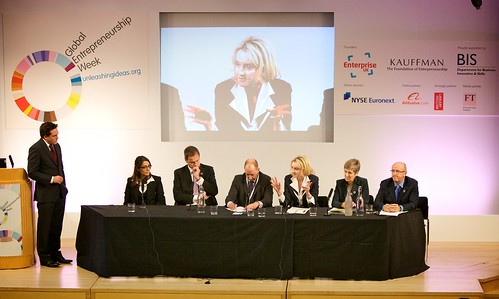
Launch of Global Entrepreneurship Week (GEW) at The British Library

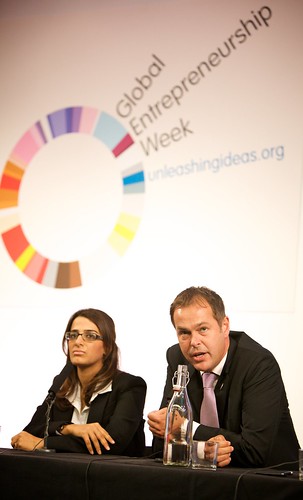
Peter Jones and Priya Lakhani from Masala Masala discuss enterprise education by Enterprise_UK.
Peter Jones and Priya Lakhani from Masala Masala discuss enterprise education

I spent Monday morning at the launch of GEW from the comfort of The British Library conference centre.

The event was well chaired by Simon Jack from the BBC, and included some light-hearted banter between him and Peter Jones (of BBC’s Dragon’s Den fame). Peter persuaded Simon to spend a day with him in order to experience the world of the entrepreneur from the inside. He also got him to agree to give a plug for GEW one morning during the BBC Breakfast Show this week, so watch this space.

1. Our Chief Executive Lynne Brindley gave the welcome speech and included the intriguing concept that The British Library has more good ideas inside it than any other building in the world. I think it is a line I can see myself using in future.

2. The opening words were from Miles Templeman Director General at the Institute of Directors. Who felt that talent is not enough to ensure success in business – inspiration is necessary to start things off. But what unless potential talent is developed and nurtured business survival and growth is unlikely.

3. Next we watched a short video from Peter Mandelson, Secretary of State for Business, Innovation and Skills.

4. Then we had a fascinating panel session with Carl Schramm the Chief Executive of the Kauffman Foundation and Jim O’Neill the Head of Global Economic Research at Goldman Sachs.

Schramm acknowledged Prime Minister Gordon Brown as the key driver behind turning the original UK Enterprise Week into Global Entrepreneurship Week, which now includes 88 countries. In order to learn how to teach people to become entrepreneurs to start high growth businesses they have created the Kauffman Laboratories for Enterprise Creation – http://www.kauffman.org/entrepreneurship/kauffman-laboratories-for-innovation-and-entrepreneurship.aspx

Their research shows that entrepreneurship has been the key to recovery of the last seven economic declines. In recessions economists and governments turn back to Keynesian economics and decide that government intervention is the key to economic recovery. Schramm believes government industrial policy is antithetical to entrepreneurship. Instead what we need is government policy and pragmatic coaching skills to support creation of new entrepreneurs. He believes there is a  sea-change occurring, so we now see enterprise as the key to economic growth, and gave the economies of China and India as proof of this.

Libraries and support – Andrew Carnegie created the US public library system – the Kauffman Foundation are looking very closely at libraries as incubators for business.

5. O’Neill who’s claim to fame is having coined the term BRIC nations (Brazil, India and China), stated that entrepreneurship is the future of our and the world economy.

  • He thought it unfortunate that economists have proved why they are known at the miserable profession.
  • The consensus forecast for world economy is 3.7%, down from 5% over the last five years. This is due to continued progress in BRIC economies. The assumption that our recession is reflected elsewhere is not true.
  • Economically speaking China has created the equivalent of 2 UK’s in the last eight years.
  • Brazil is due to overtake Italy in terms of GDP (gross domestic product).
  • In China 13 million a month taking mobile phone contracts
  • Twice as many cars will be sold in China this year than the United States.
  • The expansion of BRIC economies provides opportunities for British entrepreneurs. He gave example of UK football league as an example of world business success.

6. Question time:

The British know how to invent, but not how to market themselves.

Rod Aldrich Foundation – http://www.aldridgefoundation.com/

What is the secret to growing economies entrepreneurship success. Awareness that they have been given the chance to become wealthy. People in Britain like to be regarded as creative, but following it through to economic wealth is a cultural issue.

Over half of the US fasted growing 500 companies never wrote a business plan.

Business academies can’t spark entrepreneurial attitudes, although they can help with best practice.

7. Video from Karen Kanaan the Global Entrepreneurship Week host in Brazil. Their goal was for 1% of the population to become involved (2 million people), but actually ended up with 4.5 million people registered.

8. Panel Session:

Matt Brittin the Managing the Director of Google UK.

  • Google perspective – The Internet allows business to be global. The world has gone digital, so there is a big opportunity for entrepreneurs.
  • Example of purely gadgets digital business. Example of dustbag.co.uk, used internet searching keyword targeting to bring their service to their intention.

David Wei the Chief Executive of Alibaba.com, China’s biggest internet business.

  • Entrepreneurship cannot be educated, trained or supported by Government, it can be inspired. We need to take away comfortable safety net to create a culture of entrepreneurship.
  • Who is the new idol for entrepreneurship, why do we still see a video of Richard Branson twenty years on.
  • PowerPoint leaves your power and point on the screen. You end up with no power and no point.
  • The internet is the equivalent of the railways and highways of the last century.

Emma Harrison the founder A4E

  • Started an illegal tuck-shop at school.
  • Elected as a school governor at 15, but was still truanting from school.
  • Failed her A –levels, so went back to college to get engineering qualifications, put learner plates on a motorbike and drove to Universities to get places.
  • Joined her dad in business who left after 18 days and learnt how to survive in business.
  • Advice – find your own path, find a mentor, every day find four ways to market your business.

9. Panel discussion

  • Intro from Lord Davies, Minister of State for Trade, Investment and Small Business.
  • 4.8 million SME’s – we are a nation of entrepreneurs – appealed to the press to celebrate our success, not to concentrate on failures.
  • Peter Jones wants to introduce entrepreneurship into every school in the UK. He believes entrepreneurship can be taught.
  • Julie Meyer – entrepreneur country . net – We need to become a nation of believers (not a religious belief). A surprising lack given this country produced Winston Churchill. Business success is a like a drug, once successful they will want to help others build their success.

Panel Discussion by Enterprise_UK.

In conversation with Lord Sugar

Lord SugarTonight was definitely one of the highlights of Global Entrepreneurship Week for me. Our event in the British Library conference centre In conversation with Lord Sugar was full to bursting.

As time is short and it is now after midnight, I am going to post my notes of his gems and leave it at that.

Is now a good time to be setting up a new business?
Lord Sugar’s route into business was by learning business skills by working in a company and then applying these to his new business.

He is concerned that people wake up one day and decide to start a business, but don’t have the relevant skills or experience to make a go of it.

Opportunities currently exist in the property market if you have the money, but the banks will not be interested in lending.

His move into computers was a natural development of his business selling transistor radios, rather than a revolutionary move.

What is the best piece of business advice he has ever taken?
He used his bank as a barometer in his early days in the 1960’s to find out how fast he could and should develop. This is in contrast to more recent times when the banks give too easily and freely.

He encourages youngsters to start small with their own money and grow from there.

I have not been very successful in investing in the property market. I took all the money I earned from technology and put it into safe and boring properties. There was no rocket science in what I did.

What do you think about MBA’s in entrepreneurship
You can’t train entrepreneurs, you either have the spirit or you don’t. Business training is important but not a substitute for an entrepreneurial spirit.

Has reading business books been useful?
No, not really, I last used one for a wobbly table.

How important is a business plan?
The key point is the business idea any good. For instance if it is a service it is all about the quality of the person providing the service. No excel spreadsheet is magically going to make it work.

There is no point of any business support unless the idea is any good.

How important are work teams?
The team found Lord Sugar rather than vice versa.

Tell us about challenging periods and mistakes made.
Over 40 years in business made less mistakes than good decisions. You learn by your mistakes. He encourages young business to do a weekly health check. What has gone right this week and what has gone wrong?

How do you use sweat equity?
I’m a thick bloke from Hackney, so keep it simple. I don’t understand what you are talking about.

Advice on partnerships
When you need to add a level of expertise to your business you can either add a partner or find a suitable employee.

Can government employees give help to small business when they read them from a computer screen?
Business Links centres have the tools to take some of the burden away from business people with practical advice on employment law, tax regulations etc. They are not giving business advice, but practical help.

Common attributes for entrepreneurial spirit?
(Exasperated) I wish someone would give me an answer to this one.

Have you had a mentor?
Yes. In my business career my mentors were people I aspired to. In my family there was only my uncle. Later on my supplier of electrical equipment became my mentor. Grew beyond them on to the likes of Lord Weinstock at GEC and Rupert Murdoch. Looked, listened and tried to replicate what they were doing.

The role of PR
Differentiates the role of business PR and personal PR. Editorial on a product or service is worth more than advertising. Has a lot to do with connections with media. PR companies who don’t specialise are not as successful as the ones that don’t.

Selling and the art of closing a deal
I the person running the business is not a good sales person then why are they in business. This is another art that can’t really be taught. If you can’t do it, employ someone who is.

How do you like people to communicate in Business?
Very openly in my place, everybody shares the story and knows what is going on.

I admire people who have reached contentment with their lives and know how to enjoy themselves.

How challenging have you found this new Business Champion role?
This is not a challenge, I’m not looking for a headache. I won’t don’t it if I didn’t enjoy it. I wanted to give something back to young people

Do you invest outside of the UK?
We have in the past with electronics. I don’t have any at the moment. There are problems with investing in Africa. It is a difficult market. It needs some African entrepreneurs to create the new markets and some business traffic.

What is the main cause of the 95% of business start-up failures.
Should do a weekly health check. Immediately you know where you business is going. Do not lose track of the basics. Do the simple maths every week.

How do we encourage an enterprise culture in the UK? Rachel Elnaugh – ex Dragons Den
Programmes like Dragons Den and The Apprentice have provided a great service to this country to spread the message that there are no free gifts or free lunches. That you actually have to do it yourself. There is too much of a culture that expects to be spoon fed.

If someone could invent a positive journalist then this would encourage people. Get away from this blame culture.

I don’t like the way we have changed to a knocking culture in recent years.

What could schools do to improve things for business?
We need to make plumbing cool again.

Do you set yourself goals?
Right at the beginning it was just to earn more money than in the job I had just left. If by Wednesday I had achieve £60 of net profit then I had achieved my goal.

I never had a five year plan. In the electronics business this is bullshit. You can’t see that far ahead.

Ideas have to be endorsed by a third party, it is no good getting your friends and family to say how great it is. You need a wake call.

You make people believe in your potential by your past successes.

Business and IP Centre launches New Business Podcast featuring… me

I have to say I was somewhat nervous about being interviewed for Business Bytes. This our new monthly podcast narrated by business journalist Jamie Oliver, and designed to give inspiration and practical advice with the challenges in setting up and growing your own business.

Actually, I just do the inroduction and the really interesting content comes from designer Sebastian Conran of Conran & Partners, business expert Jane Khedair from Business Plan Services, and Dee Wright  founder of The Hair Force.

Each month, Jamie will be interviewing entrepreneurs, business experts and some of the Library’s success stories, who are just at the start of their entrepreneurial journeys. But we have hit he ground running with a mention on the Telegraph newspaper website.

Episode one: From idea to business
19 October 09
In our first pilot episode, Jamie introduces himself and the Business & IP Centre, and interviews a range of experts and entrepreneurs about the importance of ideas, how to take them to the next stage, and why you should protect them.

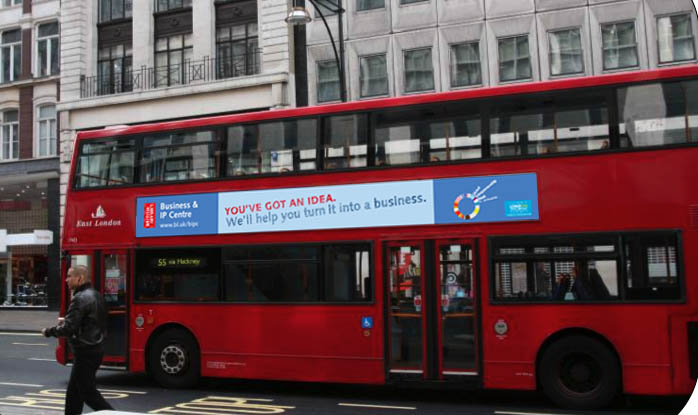
Business & IP Centre goes ‘On the Buses’

Although this has to be one of the most culturally embarassing references I have used in this blog, I couldn’t resist – now that we are advertising on London buses (see my YouTube link below if you are in need of a cringefest).

This is part of our promotional activities around Global Entrepreneurship Week, for which we have lots of exciting events, including In conversation with Lord Sugar (the event is now sold out, but you can watch online at www.inspiringentrepreneurswebcast.co.uk).

We have had great success in the past with our posters in and around a selection of London Underground stations, so we are both excited and nervous about our experiment with London buses.

Please let me know if you happen to spot one around town.

BIPC_bus_advert

.

.

[youtube=http://www.youtube.com/watch?v=9demh_RPQpc]

Our new business information wiki – Business Essentials on the Web

http://www.faronet.be/files/u16/wikipedia.jpgAs part of our continuing experimination with all things Web 2.0 (Social Media) we have created a wiki for essential business information. Still currently in beta, this wiki is a designed to allow any of my British Library business information colleagues to add useful links.
 
But more revolutionary (for the British Library) is that we are also opening up the wiki to anyone who has useful information to add. In particular our partners, who have expertise in a wide range of business support activities.
 
The wiki will be of help to people who are not able to come and visit our St Pancras building, and who find that Google does not provide all the answers.
 
Obviously we ony want useful content on the wiki, and will be taking any spam off straight away, much like you see on Wikipedia. Our wiki guidelines explain in more detail.
 
Please join our little community and add your comments and submit links of your own.
 

If you have any ideas or comments on the wiki, you can email bipc@bl.uk

What is a CRM, and when are they best used by small business? Lucidica workshop Tuesday 3 November

Lucidica_logoThis morning I managed to find the time to attend a workshop by one of our partners. Lucidica are a relatively new partner for the Business & IP Centre and currently provide six workshops related to IT and business.

This particular half day workshop on what is a CRM (Customer Relationship Management), and when are they best used by small business, was presented by immensely knowledgeable founder and Chief Technology Officer (CTO) Thomas Jeffs.

He got straight down to business by explaining that a successful CRM implementation requires both staff discipline and management buy-in. With out both of these you will be wasting both your time and and your money.

Here are my notes from the morning:

What can a CRM system do?

1. Contact Management

  • the most basic function of a CRM
  • who they are
  • what they are doing
  • central point for all staff

Shared office address book – suppliers – customers – for many business this is just a piece of paper stuck onto a computer terminal

if people don’t use it and keep it up to date it become worthless

2.  Sales Force Automation – now the most popular aspect of CRM – making sure you make the best use of your sales force

  • What to do and when, with regards to sales and follow ups
  • Helps make sure you chase opportunities when you need to
  • Allows you to forecast your predicted sales and leads – only tends to work on larger scale of operation
  • Allows you to see how your sales agents are doing
  • Essentially automating your sales force and sales force reporting
  • Benefits not so clear to staff due to reluctance to fill in details of customer interactions

3.  Marketing Campaign Management – linked to previous activity

  • How much did £100 in marketing spend raise in sales?
  • How many leads did a marketing campaign generate?
  • How many internal resources were required as a result of a marketing campaign? E.g. Did it attract the wrong kind of customer who were ‘high maintenance’?

4. Customer Service Management – support tickets – complaints – consistency across the Business & IP Centre

  • A centralised place for tracking – breaks dependency on one member of staff
  • Can provide automated responses to issues. E.g. generated ticket number and expected response from the company
  • Can monitor and escalate issues if still outstanding
  • Result in – consistency  and efficiency of service
  • Benefits clearly visible to staff and customers

It is important to establish which of the above are the most relevant to your business, as this will have an impact the the most suitable package for you.

How do CRM systems help your business?

1. How do they do it? – Automation

Health warning

–       Automation to internal users is good

  • Creation of follow-up tasks/ reminders
  • Workflow tools
  • Creation of templates, timelines and standards

–       Automation to external users is mixed

  • Acknowledgement of complaints/issues/feedback work well
  • Automated quarterly sales email – don’t work so well – de-personalises the business.

2. How do they do it? – Tracking / Recording

–       Change of address for existing clients

–       Client moves to a new company

–       Recording emails and phone contacts with sales leads

–       Recording information that client is under contract with competitor for next three months

–       Has your entire team access to this information

3. How do they do it? – Reporting

–       Reporting is the purpose for a CRM for management

–       Some things a CRM can tell you:

  • Predicted sales for next three months
  • Which clients haven’t been in contact for a while
  • Which sales agents are getting the most leads
  • Which sales agents are making the most sales
  • Which contracts are up for renewal
  • What total sales have you achieved from each marketing campaign
  • Which clients have service level issues
  • Which people work for which clients

Thomas reviewed several case studies based on real experiences at Lucidica.

Which CRM is right for you?

1. Which CRM? – Questions to ask

  1. What is the function of the CRM?
  2. What will it need to integrate with?
  3. Who will need to use it, and from where?
  4. What is the potential benefit for my business in £’s?

2. Which CRM? – Quick and dirty recommendations

–       Excel – 1st choice for people thinking about what they need to track

–       SharePoint – 1st choice for precision applications and power users

–       Sage ACT! – 1st choice for integrating into Outloook and Sage, below 10 users, primary use for contact management and sales force automation

–       SugarCRM – 1st choice for Linux users

–       SalesForce.com – 1st choice for users with little infrastructure and who rely on internet traffic for business

–       Goldmine – 1st choice for businesses with over 10 users but can’t afford Microsoft CRM

–       Microsoft CRM – 1st choice for businesses with high volume of sales and contracts

Summary

–       Make sure your CRM does not have superfluous functions

–       Make sure it can scale both up and down

–       Make sure you can get your data out of the system

–       start small and evaluate after six months

Lucidica Technology Seminars

Search Engine Optimisation (SEO)

– how to improve your website so search engines, like Google, lists or ranks it better/higher.

Email Marketing

– how to use professional looking emails, in bulk, to market effectively, and/or keep your clients informed (e.g. newsletters).

Technology “Must-Have’s” For Small Businesses

– from the best computers and laptops, virus-protection and back-up software we know of; to “what is a server and when does my business need one” and many free software and technology tips to reduce technology risk and increase value in your business.

An Intranet and more with Microsoft Sharepoint

– touted as a big thing in the 1990s, Intranets are finally adding value to business – especially small business now they are affordable with products like Microsoft Sharepoint. In this seminar we explain what an Intranet is, how you can use Sharepoint and how to get this powerful solution from Microsoft for FREE. We’ll talk and show you how you can use Sharepoint for your own CRM, wiki, time sheeting forms and reporting, expense summary forms, other procedures and forms with built-in workflow and much, much more.

What is a CRM, when are they best used by small business and which one to select

– Client Relationship Management (CRM) software can bolster your relationship with existing clients as well as help you work on your prospective client contacts better and more frequently with ease. We’ll outline what a CRM, how it should be used for small business and profile the top 4 or 5 CRMs affordable to small business.

Designing, developing and maintaining an effective website

– every small business should have a website. Here we dispel many myths about designing, developing and maintaining a website – it’s really not that hard! For most websites we design and build for our clients we recommend they buy some great Adobe software which allows them to maintain their website like they edit Word documents. We provide plenty of advice and tips on what is a good design, and what your developers should be including in the code when they build it.

Book review – From Inventor to Entrepreneur by Celia Gates

celia-gatesHaving met the Celia a couple of times in the Business & IP Centre  I am aware of the both the passion she has for turning inventions into business, as well as the tremendous challenges she has faced on her journey.

So I was fascinated to see how she would express these in her new book. As with all entrepreneurial ideas this book came about because it wasn’t there when Celia needed it. In other words there was a gap in the market which meant both an opportunity to help other people in the same situation.

I’ve met quite a few inventors since joining The British Library and I now recognise Celia’s description of the inventor’s mindset after having had a light-bulb moment.

‘One of those burning ideas that bores deep into your head, gives you a rush of excitement and keeps you awake at night. You simply can’t stop thinking about it and the more your do, the better it gets. You know you’re on to a ‘winner’ but, the question is:

What on earth are you supposed to do with this idea next.


It’s with this question in mind that I have written this book. It’s the book I wanted to read when I first had my idea. I searched for it, but it didn’t exist – now I hope to put the knowledge and experience I have gained to use by helping you. The advice and guidance offered herein is cheap at the price. It has cost me at least £94,000 in expensive mistakes to acquire. The intention is to save the you the same peril but, you must be warned in advance; this book is not for the feint hearted.’

http://images.nitrosell.com/store_images/4/791//customcontent/0/Alessi%20Logo.jpgCelia is more of a creative designer than traditional inventor so I was fascinated to see that one of her earliest influences was a visit to the Alessi factory in Milan. As a fan of their products for nearly thirty years I can relate to this inspiration.

Almost everyone I meet has had a light-bulb moment at some point in their life (many have claimed to have been the first to come up with the idea of wheels on suitcases). However, the key is what they do next. According to Celia, out of 33,000 ideas, only 3,000 ever get written down, out of those only 300 are developed further, 3 of those are filed for official ownership (e.g. a Patent application), and only 1 idea goes on to become a reality in the market place.

For Celia the idea is secondary in the route to market, the primary factor is the inventor.

‘You are totally and utterly responsible for the success of your idea. Turning and idea into reality has everything to do with you. You and the belief and action you are prepared to take in order to turn your idea into a phenomenal success.’

As Celia correctly points out, the very first thing you should do with your brilliant idea is to value it. Far too many inventors devote time and money developing and protecting their idea, only to find out it will never be commercially viable.

1. You need to work out who (and calculate how many) will benefit from your idea.

‘Avoid sweeping statements such as ‘everybody in the entire world is going to benefit’

Concentrate on who is going to benefit the most, and so who are likely to be your first customers.’

2. Find out how accessible you target market is. How are you going to get to meet them to talk about your idea and get their reaction?

3. Work out who you are going to be competing against. Many inventors say they are creating a new market with their idea, but even where this is true existing businesses with either feel threatened or, see a new opportunity and will respond.

4. Clearly identify your competitive edge. Why is you idea so much better than anything else on the market?

5. How sure are you of being the original creator of your idea? Similar ideas often occur simultaneously, so keep watching out for your idea in patent searches and trade magazines.

Celia has adapted the famous Edward De Bono Six Thinking Hats Principles into what she terms The Whether? Forecast. This is to help view the idea from a range of perspectives:

Sun – think sunny positive thoughts about your idea.
Rain – concentrate on all the negative aspects, and what could go wrong.
Snow – clean sheet thinking. Imagine the landscape is covered by snow and start again.
Blue Sky – think creatively, don’t be constrained to the known.
Environment – look around you and consider the physical environment in which your idea will function.
Whether Report – review the evidence and your research. Look for gaps in your knowledge and try to fill these. Examine past trends and historical patterns to help predict the future.

The importance of building prototypes is covered;
‘They say that a picture speaks a thousand words: in this case a prototype speaks a thousand pictures.’

Apparently James Dyson built 5,127 prototypes when developing his dual-cyclone vacuum cleaner.

The book gradually moves towards more entrepreneurial activities, such as the need to develop an elevator pitch. This is something inventors are particularly bad at in my experience. Too often they go into far much technical detail, forgetting to emphasise the benefits of their invention to the consumer.

In chapter eight Celia attacks the tricky issue of selling intellectual property. Many inventors really struggle with this concept as they don’t trust anyone else to take proper care of their ‘baby’. The chapter starts with the following:

‘How to get rich from your invention

So, let’s start by overcoming a barrier: are you an inventor or an entrepreneur? With a little luck you are an Inventive Entrepreneur and in this case you are in line to make some BIG MONEY…

… but before we proceed, how do you feel about this?

Are you in the invention game to make BIG MONEY or are you inventing because it is your hobby or because it rewards you in other ways?

There is absolutely nothing wrong with doing something because you enjoy doing it. The world needs more social entrepreneurs and if you are in this business solely because you believe you are capable of adding infinite value to the lives of many other through your ideas then you have my utmost respect.

Her in the UK we seemingly ‘hate the concept of making BIG MONEY and yet, if we open up and are honest with ourselves, the concept of infinite riches is what stimulates and motivates many of us every day.’

I have to take issue with Celia on this point, as in my experience most inventors are more motivated by wanting to see their invention come to life, rather than making millions of pounds from it.

The rest of the book covers how to get your product into the market place, including starting production, getting attention, testing and optimising, brands and assets and return on investment.

Celia’s own experiences (and those of many other inventors) lead to the inclusion of a lengthy chapter on what to do if someone has stolen your idea.

In summary, I would say that although this book is quite quirky in places, it sees the world through an inventor’s eyes. It strongly emphasises the point that – yes – the innovative idea is essential, but unless the inventor can morph themselves into an entrepreneur then their idea is likely to remain just that, an idea, rather than a product consumers can benefit from.

From Inventor to Entrepreneur by Celia Gates


  • Helping you acquire essential knowledge & skills by learning how to save time & costly mistakes.
  • How to generate innovative & original thoughts.
  • How to develop ideas as valuable assets.
  • How to secure & register official ownership.
  • How to commercialise an innovation & turn the value of you intellectual property in to riches & wealth.
  • How to stop your ideas being stolen & optimise your return on your investment.

http://www.howtoinvent.info/Images/InventorHelp.gif

Micro Men and the birth and death of the personal computer – 1980 to 1985

Last night I watched Micro Men, another in the recent BBC series of dramatised portrayals of historical events from the 1970’s and 80’s, such as Margaret Thatcher: The Long Walk to Finchley.

This was the story of the battle for dominance in the newly emerging personal computer market from in the early 1980’s. It was also a personal clash between eccentric inventor of the pocket calculator Sir Clive Sinclair and Chris Curry (formerly his right hand man).

The film cleverly interwove news footage from the period and actors, effectively reawakening memories of my involvement in that era as a callow youth.

In particular I remember the excitement young people felt at the rapid development of the technology, and how we thought they would change the world. One scene from the seminal BBC Computer Programme talked about how personal computers would replace manual typewriters and much of the associated office paperwork. (here are some snippets). It was also something of a shock to remember how Britain led the world for that brief period, with by far the highest rate of ownership of personal computers. There was an optimism that this lead would give us an immense advantage in this newly emerging industry.

As with so many cutting edge technologies of course expectations far outstripped reality. As a ‘programming expert’ with 98 per cent in my Computer Science ‘O’ level, my father presented me with a brand new £99 Sinclair ZX81 and asked me to show him what it could do. My memory is a bit hazy on the details, but I seem to remember that its state of the art 1k of memory (compared to 2 gigabytes in today’s computers), allowed me to create a spreadsheet about 5 rows high and 16 columns wide. Unfortunately that didn’t leave any room for calculations or content.

However this did not dim my nerdish enthusiasm and I went on to study Computer Science at ‘A’ level using a Commodore Pet, and then to university on Apple II computers. It was only when I came to leave university and was pondering which model of personal PC to buy, that reality dawned. I remember my cousin asking me what I would use it for. Programming of course was the main purpose, but outside the learning environment that was not a practical application. Games were next, but the basic ones available did not appeal to me. The applications we take for granted today such as word processing and spreadsheets were not established at that time. I decided to save my £600 and wait for the technology to develop.

Which brings me to the point of this blog. Today we are surrounded by personal computers which have profoundly affected how we live our lives. Whether it is the constant bombardment of emails via Blackberries, shopping over the Internet, sharing our lives through social networking, watching or listening to films, television or radio on our iPods and personal media players, meeting new life partners through internet dating (7.8 million in the UK alone), spending time in virtual realities like Second Life, or just computing on the move (I am writing this on the train sitting next to another laptop owner – who appears be writing a gripping novel – from my furtive glances)

So although the personal PC went from boom to bust in just five short years between 1980 and 1985, apparently taking its future promise with it, the long term impact of computers on our lives has been truly revolutionary.

The footnote at the end of the show reminded me of how the two companies at the centre of the story subsequently went in very different directions. Clive Sinclair returned to his obsession with creating the world’s first mass produced affordable electric car. And produced the legendary Sinclair C5, perhaps the single most spectacular failure in the history of personal transport with sales of less than 12,000.

However, the chip that powered Chris Curry’s Acorn computer went on to be developed into the ARM processor, which has gone on to become the most successful computer chip ever, with over 10 billion shipped to power the majority of mobile phones manufactured across the world.

Starting a business is like playing at Pooh Sticks

Bryan Mills

During a recent training event I was fortunate to hear Bryan Mills speak. Bryan has had a long and successful career creating and managing IT related businesses (although without an IT background himself). His particular claim to fame is building CMG from a two person business, operating from the founder’s homes in 1965, into a multinational FTSE1oo business.

During his fascinating talk recounting lessons learnt from a lifetime as an entrepreneur he used the analogy of playing Pooh Sticks for business start-up.

As both a fan of the game from early childhood, and having grown up very near to the home of Winnie-the-Pooh the inventor of the game in Hartfield, West Sussex, Bryan caught my attention.

When you are planning to start a business you look down into the swirling river below (the market place for you product or service), you try as hard as you can to see where the current is flowing strongest and is least turbulent (assessing the market opportunity with published and field market research). You drop your stick in as carefully and accurately as you can (detailed business plan preparation). And once it is in, you follow it with Eagle eyes, watching every bob and weave (you track every activity minutely in your newly founded business).

However once the stick goes under the bridge it moves both out of your control and out of sight, and there is nothing you can do to influence its route down the river, across into a bank of reeds, or dropping down to the bottom of the river bed. This is very much the situation once your business is up and running. All kinds of unpredictable events can knock you off course, or sink the business altogether.